
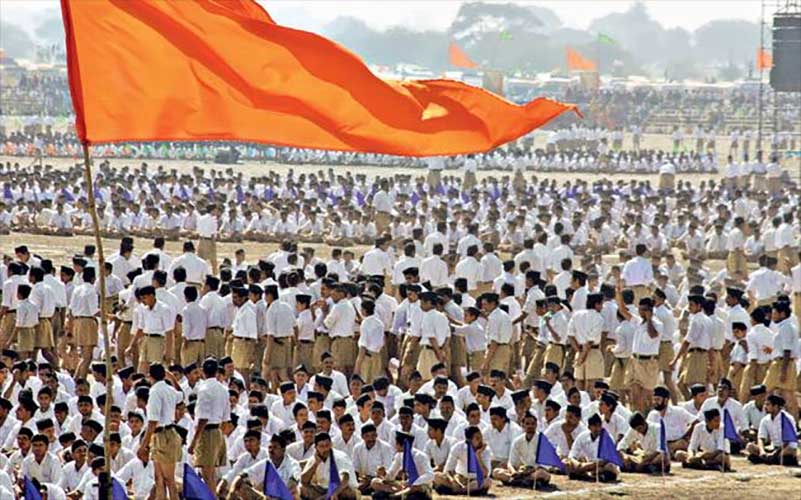
Last twelve years of RSS Pariwar union government’s performance has been defined by polarized outcomes. While the government pushed successfully digital infrastructure and targeted welfare to the masses, high unemployment, rising economic inequality, democratic backsliding and the erosion of institutional independence have been witnessed as severe shortcomings. A critical breakdown of the government’s performance across key sectors highlights both the achievements and significant areas of failure. There is a powerful and continuing nationalism that is searing into our national fabric. It is superficial. It is xenophobic. It is narrow. It is the lust to divide and not the desire to unite.
The Supreme Court of India’s orders of May 27, 2026 allowing validity of SIR (Special Intensive Revision) of electoral rolls gives the Election Commission of India cart blanche for massive exclusion of minority community voters and other marginalized people, considered non-RSS Pariwar voters, and inclusion of much larger pro ruling RSS Pariwar voters as has happened in recently held State Assembly elections in five states including one union territory. Now it will extend to all states and union territory assemblies, to help the ruling parties rig elections without any public accountability. So far, the people used to choose the government. Henceforth, the government will choose the voters. The impugned judgment is a blot on the highest court of justice after the ADM Jabalpur judgment. This endangers and sounds death knell to democracy and the rule of law based system of constitutional governance. It’s all the way electoral fascism in India. The apex court, known in the scheme of the Constitution, has openly supported the RSS Pariwar, to deprive people en masse of their inherent constitutional right to vote.
The government, though sworn in the name of and allegiance to the Constitution of India, has been functioning openly in violations of the basic tenets of the Constitution, like Justice, Liberty, Equality and Fraternity, without regards to national unity, communal harmony amidst unity of diversity, and the very fabric of the nation. At this rate, country will break apart as people are driven to the stone wall wherefrom they would not have options but to fall apart. All the way, fractious, discriminatory, unfair, malicious, toxic and exclusionary conduct is overflowing to the people. Even Parliament is not allowed to function as the highest public forum to ventilate people’s issues. Voices of dissent are blocked. Bills are passed without consultation with stakeholders and consensus. All time high corruption is rampant. All persons at the helm of public affairs governance are notoriously under cloud of suspicion of being corrupt with no accountability to the people. All institutions including the judiciary have collapsed with the rule of law based constitutional democracy having altogether collapsed.
The government has shown resounding disdain for human rights. NHRC has become dysfunctional or redundant. The number of hate crimes has gone up many times more as can be seen in the data of various national and foreign research organisations. The country also witnessed unimaginable control and subjugation of mass media. India’s TV channels spend the majority of air times broadcasting propaganda for the RSS Pariwar. In fact, it has become Prime Minister centric. An obsession with national security has been witnessed, creating an atmosphere of fear, pervading the country, with new enemies being created everyday.
The government and religion are now intertwined. We have redefined what it means to be a citizen. Laws have been amended to target minorities. Also being witnessed is a complete disdain for intellectuals and the arts, and the repression of all dissents. These are the most dangerous signs of all that are pushing India back to the Dark Ages. The last sign has been total loss of independence in our electoral system.
Since 2014, political scientists, critics, human rights organisations and the general public have increasingly used the term ‘electoral fascism’ or ’illiberal’ democracy to describe India’s political trajectory under the RSS Pariwar union government. This framework highlights now the ruling party maintains democratic processes with systematically eroding constitutional safeguards and the rights of minorities.
Key characteristics of the trajectory comprise majoritarianism and ethno-nationalism, institutional subversion and hollowing out, suppression of dissent, centralization of power in one man (PM) and his deification, citizen denationalization, judiciary losing its independence, fairness and neutrality by turning into ‘executive courts’ with only individual judges outshining.
On economic front, country recorded sluggish private investments and the failure of the ‘Make in India’ initiative to significantly boost the manufacturing sector’s share of GDP or create large-scale high quality jobs. High unemployment rates, especially among the youth, remain a persistent challenge. Despite welfare distribution, wealth inequality has grown substantially, with corporate profits soaring, while lower income households struggle with continuous inflation and low wage growth. India’s persistent poor showing on the Global Hunger Index 111th position out of 125 countries continues to spark debates over the actual eradication of malnutrition. Besides, demonetization in 2016, Covid pandemic, and complicated GST in 2017 knocked down economy with massive unemployment in small and unorganized sector.
Human rights organisations and political analysts maintain there has been an erosion of democratic institutions, a shrinking space for and weaponisation of free expression, and increased pressure on the judiciary and investigative agencies. Further more, the ruling Sangh Pariwar’s ideological focus has alienated minority communities and fostered religious polarization. In the arena of foreign policy, India remains exclusionary at home and inclusive abroad resulting in total failure of foreign relations. It is altogether PM centric and his projection abroad. Ties with immediate neighbours remain strained. Border disputes, particularly the prolonged military stand off with China along the Line of Actual Control, and failure in the Gulf and West Asia vis-à-vis Israel-America war against Iran remain significant foreign policy and security challenges.
Scientific temper policy, enunciated in 1957, has become redundant and country is sliding to the dark ages. Electoral fascism has overtaken the nation along with the gospel of RSS Pariwar the Manusmriti for all practical purposes, in the process the Constitution of India is undermined or subverted while maintaining all the trappings of the rule of law based constitutional democratic governance. Despite the collective responsibility of council of ministers, it is the PM everywhere or nowhere. Ministers do not count, except for formality. All decisions are taken in the name of PM, even announced by PM, not by the minister concerned. People of India hardly know the Ministers except a few old faces. In the scheme of the Constitution of India every minister is Government of India in respect of areas under his/her charge. Only in the matter of policy decision, cabinet ministers take collective decision in cabinet meetings presided by the PM.
Electoral fascism has overtaken India under the RSS union government since 2014. This phenomenon reflects the slow, incremental erosion of democratic institutions through the democratic process itself. The ideological shift manifests in several distinct ways, like majoritarianism, minority marginalisaion, institutional hollowing with statutory bodies, Enforcement Directorate (ED), Central Bureau of Investigation (CBI), and the Election Commission, widely criticized for exhibiting partisan bias. State machinery has frequently been utilized to suppress political opposition, jail critics, and limit press freedom. The marginalization of Muslims like the CAA, NRC, and abrogation of Article 370 in Kashmir, has heightened concerns about the transition toward a Hindu-first nation.
The ruling apparatus has increasingly blurred the lines between the party, the leader, and the state, meaning any opposition to the BJP’s policies is frequently labeled as anti-national. Scholars characterize this dynamic as a “slow bleeding process”. Rather than a sudden dictatorial seizure of power, democracy is maintained in form while the constitutional substance and human rights protections are systemically hollowed out from within!
Leave a Reply